Oddseal guide · House bill of lading
How to redact a house bill of lading for a commercial copy
Redact a house bill of lading only when you are creating a clearly defined commercial copy and the recipient does not need the complete operative bill. Review party identities, charges, contacts, and cross-references, but preserve cargo, routing, carriage, and regulatory facts required for the recipient's task.
Oddseal editorial · Published August 22, 2026 · Updated September 28, 2026
Oddseal is responsible for this guide and its synthetic examples. Document requirements are linked to the sources below; product claims describe their stated scope. Report an error or suggest a correction.
What is a house bill of lading?
A house bill of lading is issued by a freight forwarder or non-vessel-operating common carrier to its shipper. The Federal Maritime Commission describes an NVOCC as a common carrier that issues its own house bill of lading or equivalent document while using a vessel-operating carrier for the ocean movement.
That role makes the HBL more than a convenient shipment summary. It can identify the parties, evidence receipt or carriage terms, connect cargo to other transport records, and support release, banking, insurance, or claims. Treat the original and every operative copy as controlled records. Use redaction only for a separate commercial disclosure whose recipient and purpose are explicit.
Worked example · entirely synthetic
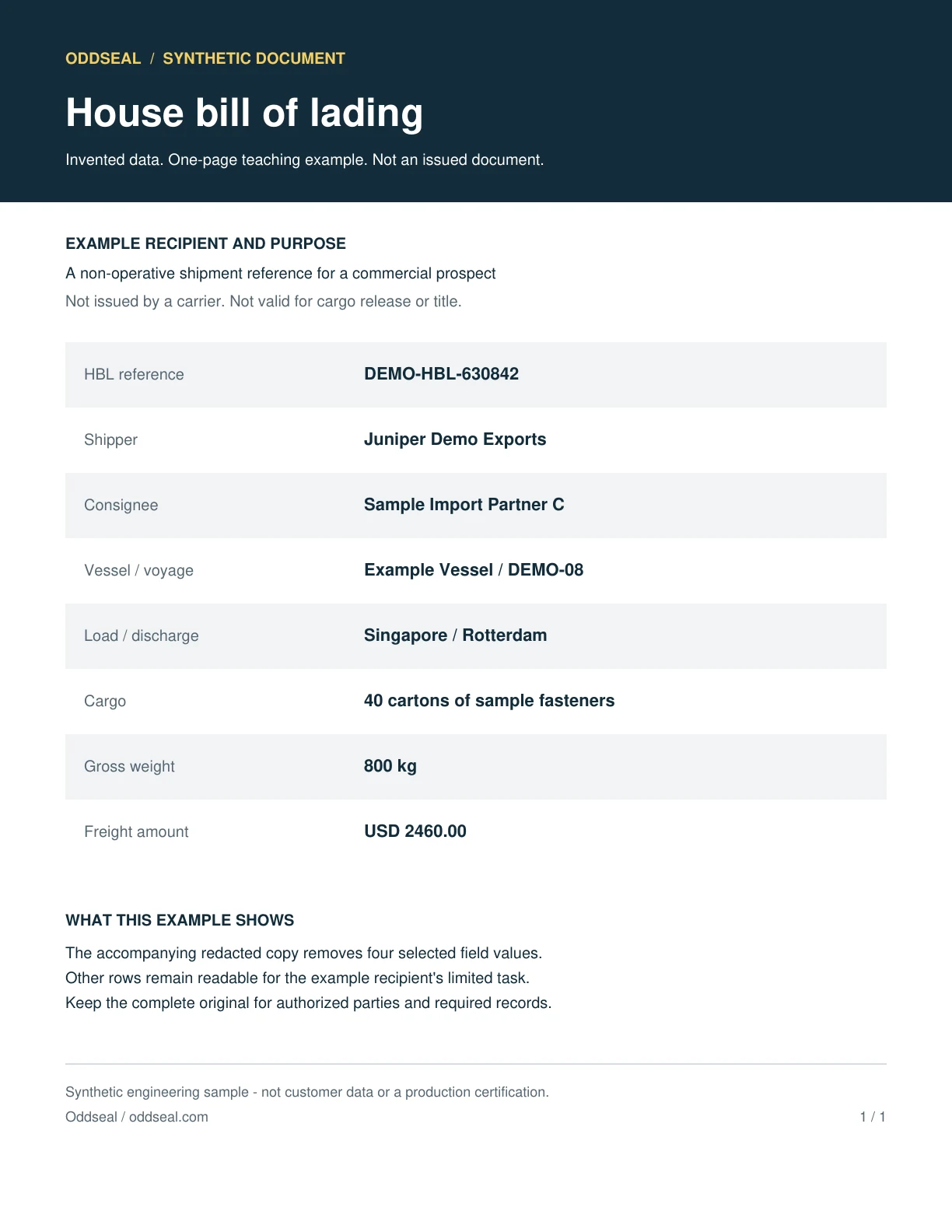
A house B/L used as a document example
A commercial reviewer needs to see the route and cargo layout, not the shipment's parties, reference, or freight amount. This invented copy keeps the voyage, ports, cargo, and weight visible. It is not an operative bill or a replacement bill, and it does not hide the shipment completely: retained routing information can still identify it.
Source example
Redacted example
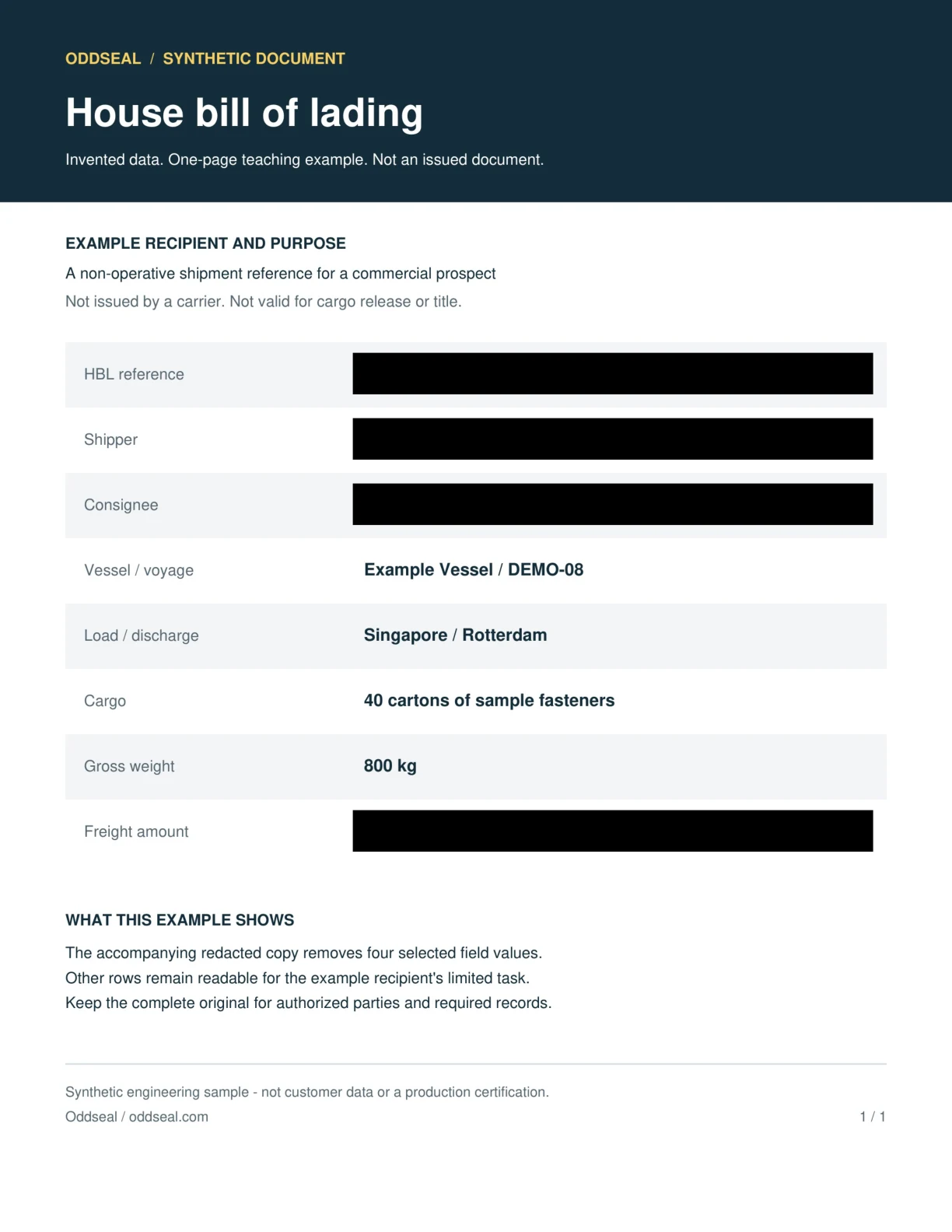
- Removed in this example
- HBL reference · Shipper · Consignee · Freight amount
- Kept visible for this recipient
- Vessel/voyage · Load/discharge · Cargo · Gross weight
The sample was generated and checked locally with Oddseal’s engine using four manually selected regions. The redacted PDF was built the same way as in the product: each page rendered to a fresh 240-DPI image with the masks burned in. The evidence download records file hashes, versions, and the checks run.
Those local checks include page-level comparisons from Oddseal’s offline test profile that the product does not run on every document. Before sharing, the product runs a narrower check: an independent readback of the stored file plus a structural check.
The output samples are image-only PDFs with no searchable text layer. An empty text search is expected and cannot establish that a visible region was removed. Compare the page images and read the check evidence.
This is engine-level evidence for invented examples. It does not test automated detection, a production account, the application’s release checks, or share links. It is not a claim that every sensitive detail was found.
Which house B/L fields deserve review?
Read the document as a connected record. Removing one name may not hide the party if logos, references, addresses, or instructions identify it elsewhere.
Shipper, exporter, consignee, and notify party
Names, addresses, tax identifiers, and logos can expose commercial relationships. They may also define delivery, notification, or legal responsibility, so the recipient's role controls the decision.
Reference: Vessel manifest requirements for importers and carriers
Freight charges and payment notation
Review prepaid or collect terms, charge lines, buy-side amounts, and notations such as As Arranged. Keep any charge or term the recipient must act on.
HBL, booking, and cross-reference numbers
Identifiers can reconnect a redacted copy to manifests, invoices, carrier portals, and internal files. They can also be necessary for release or claims.
Vessel, voyage, ports, and place of delivery
Routing data is normally operational. Remove it only when the copy is evidence of document structure rather than evidence of a particular movement.
Cargo description, packages, weight, and marks
These fields may reveal the trade or supplier, but they are core carriage and customs facts. A recipient handling the shipment usually needs them intact.
Reference: Vessel manifest requirements for importers and carriers
Signatures, stamps, and personal contacts
Review issuer signatures, agent stamps, direct email addresses, and phone numbers when the disclosure does not require personal attribution.
What should stay visible on an HBL copy?
A useful copy keeps every fact the recipient needs to release, move, insure, finance, or evaluate the cargo.
Named shipper, consignee, or notify party
- Keep visible
- Keep their identity, shipment references, routing, cargo facts, release terms, and any charges they must pay.
- Review before sharing
- Review upstream supplier relationships, internal references, unrelated contacts, and buy-side pricing that does not govern them.
Commercial prospect or diligence reviewer
- Keep visible
- Keep dates, document structure, general routing, and enough cargo context to support the stated review.
- Review before sharing
- Review party identities, exact references, signatures, container numbers, and commercially sensitive charges.
Subcontractor supporting one leg
- Keep visible
- Keep the instructions, locations, cargo facts, contacts, and references required for that leg.
- Review before sharing
- Review unrelated counterparties, commercial margins, banking data, and references for other legs.
Carrier, customs, bank, insurer, or cargo-release party
- Keep visible
- Send the complete accepted bill and supporting records.
- Review before sharing
- Do not substitute a redacted marketing, tender, or diligence copy for an operative HBL.
How to redact a house bill of lading copy
Keep the original HBL outside the redaction workflow and define the derivative before selecting fields.
- 01
Confirm the copy is non-operative
Ask whether anyone will use it for carriage, title, release, customs, banking, insurance, or a claim. If yes, use the complete accepted document.
- 02
Map the recipient's task
List the routing, cargo, party, charge, and reference fields the recipient must see. This list becomes the exception check.
- 03
Review every page and repeated field
Check the face, terms, continuation pages, stamps, signatures, headers, footers, and attached schedules. An identity may appear in several formats.
- 04
Remove only the approved targets
Create a fresh derivative without copying the source object graph or leaving live text under visual marks.
- 05
Check identifiers as a set
Review whether remaining HBL, booking, container, purchase-order, and invoice references could identify the shipment. Removing party names alone does not stop a reader from identifying the shipment.
- 06
Check, label, and share
Open the output and confirm each selected field is covered and the routing and cargo facts you kept are readable. Label it for its commercial purpose and share it separately from the operative record.
What does Oddseal check on an HBL copy?
Oddseal applies the selections the human reviewer approved to a new PDF and withholds download and sharing until the pre-share check passes.
What the check covers
- Selected party names, charges, references, and signatures are burned into black masks on a fresh 240-DPI page image. No text or object from the source HBL is left underneath.
- Before download or sharing, an independent reader opens the stored file and confirms the expected page count, no extractable text, and no attachments, JavaScript, or open action, alongside a structural check of the file.
What it does not cover
- It does not check that every value you meant to remove was selected. A value you leave unselected stays visible in the image.
- It does not make the copy negotiable, operative, or acceptable to a carrier, authority, bank, insurer, or court.
- It does not show that detection found every field that could identify the shipment or parties.
Sources and evidence
These sources explain the document requirements, redaction methods, or example checks cited in this guide. Requirements vary by document, route, contract, and jurisdiction. A linked proposal is background, not an operative rule.
U.S. Customs and Border Protection
Vessel manifest requirements for importers and carriers
Explains required shipper, consignee, cargo, and shipment information for U.S. vessel manifests. A limited commercial example does not replace that filing.
Federal Maritime Commission
Ocean Transportation Intermediaries
Defines the NVOCC role and its issuance of a house bill of lading or equivalent document.
FIATA
Digital FIATA Bill of Lading
Describes issuer identity, document validity, content integrity, and the audit trail for the negotiable FIATA multimodal transport bill.
FIATA
FIATA documents and resources
Lists standard FIATA transport documents and guidance for freight forwarders.
Information Commissioner's Office
Disclosing documents to the public securely
Provides practical guidance for permanent redaction and checking hidden information in disclosed documents.
Related reading
Check a redacted freight PDF
Test the output yourself and see what Oddseal's pre-share check covers.
Why black-box redaction fails
See how drawn boxes leave text behind and how to test a PDF for it.
Freight document redaction guide
Start with the recipient, purpose, and general review workflow.
Switch B/L supporting paperwork
See why the carrier-issued switch bill and its surrounding documents require different handling.
Redact a commercial invoice
Review invoice fields without weakening a customs or payment record.
Start on Oddseal’s Free plan: 5 documents a month, no card needed.