Oddseal guide · Freight rate confirmation
How to redact a freight rate confirmation before external sharing
Redact a freight rate confirmation only for a recipient who does not need the complete broker-carrier agreement or transaction record. Protect buy-side rates, carrier or customer identities, bank details, and internal references while preserving the terms, instructions, and charges required by the person performing or reviewing the shipment.
Oddseal editorial · Published August 22, 2026 · Updated September 28, 2026
Oddseal is responsible for this guide and its synthetic examples. Document requirements are linked to the sources below; product claims describe their stated scope. Report an error or suggest a correction.
What is a freight rate confirmation?
A freight rate confirmation records the commercial terms agreed for a shipment, commonly between a property broker and a motor carrier. It may state the carrier, shipper or facility details, route, equipment, rate, fuel or accessorial charges, payment terms, and operational instructions. Those details help perform and settle the move, but they can expose a broker's buy rate or customer relationship when the document is forwarded outside that agreement.
The rate confirmation is not the complete broker transaction record. In the United States, 49 CFR 371.3 requires brokers to retain specified transaction information and gives each party to a brokered transaction a right to review that record. A redacted commercial copy should never overwrite the full agreement or the records retained for the transaction.
Worked example · entirely synthetic
A rate confirmation for a service example
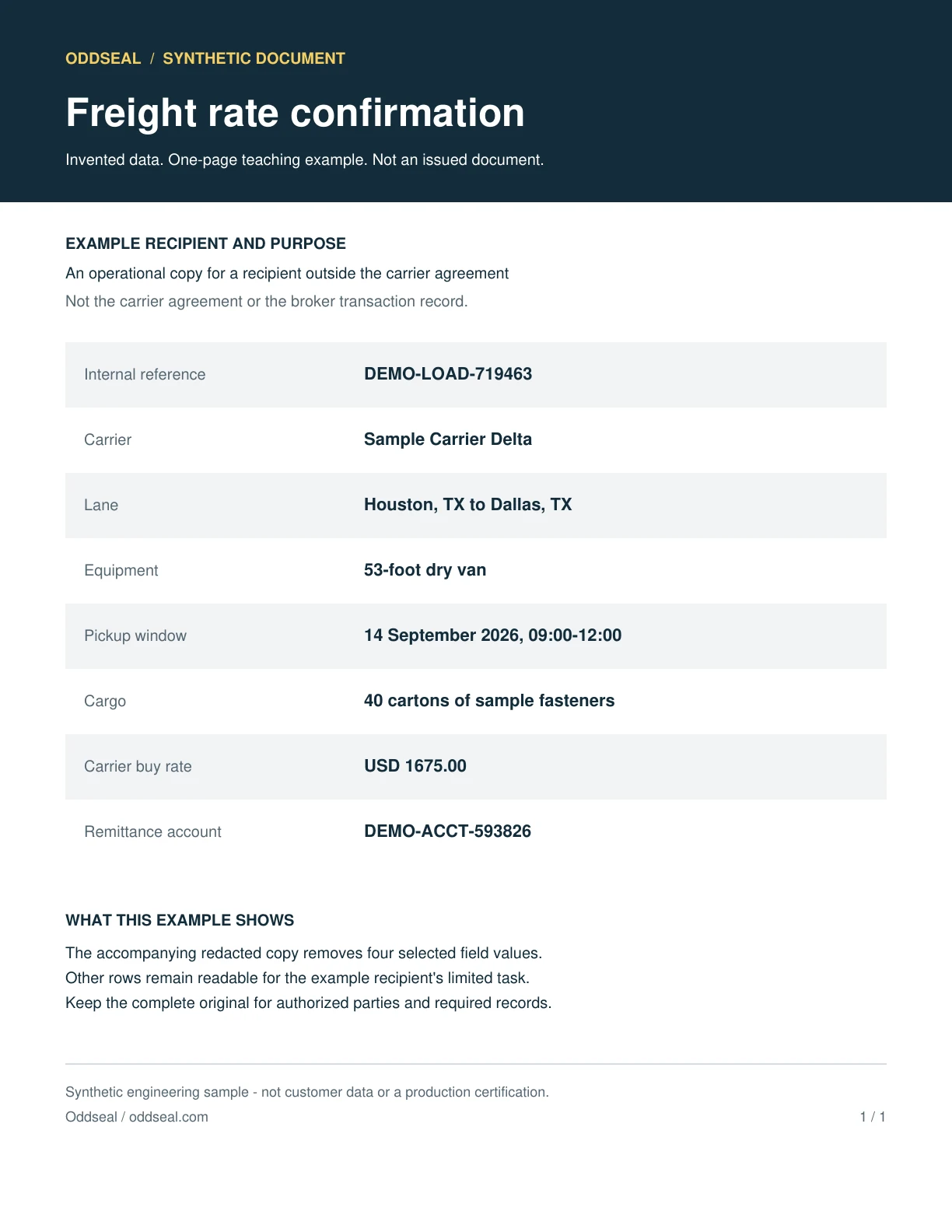
A prospect is reviewing the lane, equipment, pickup window, and cargo in an example of the service. The copy removes the carrier identity, buy rate, internal reference, and remittance account. The contracted carrier would need its agreed rate and identity visible; do not use this limited copy in place of that agreement.
Source example
Redacted example
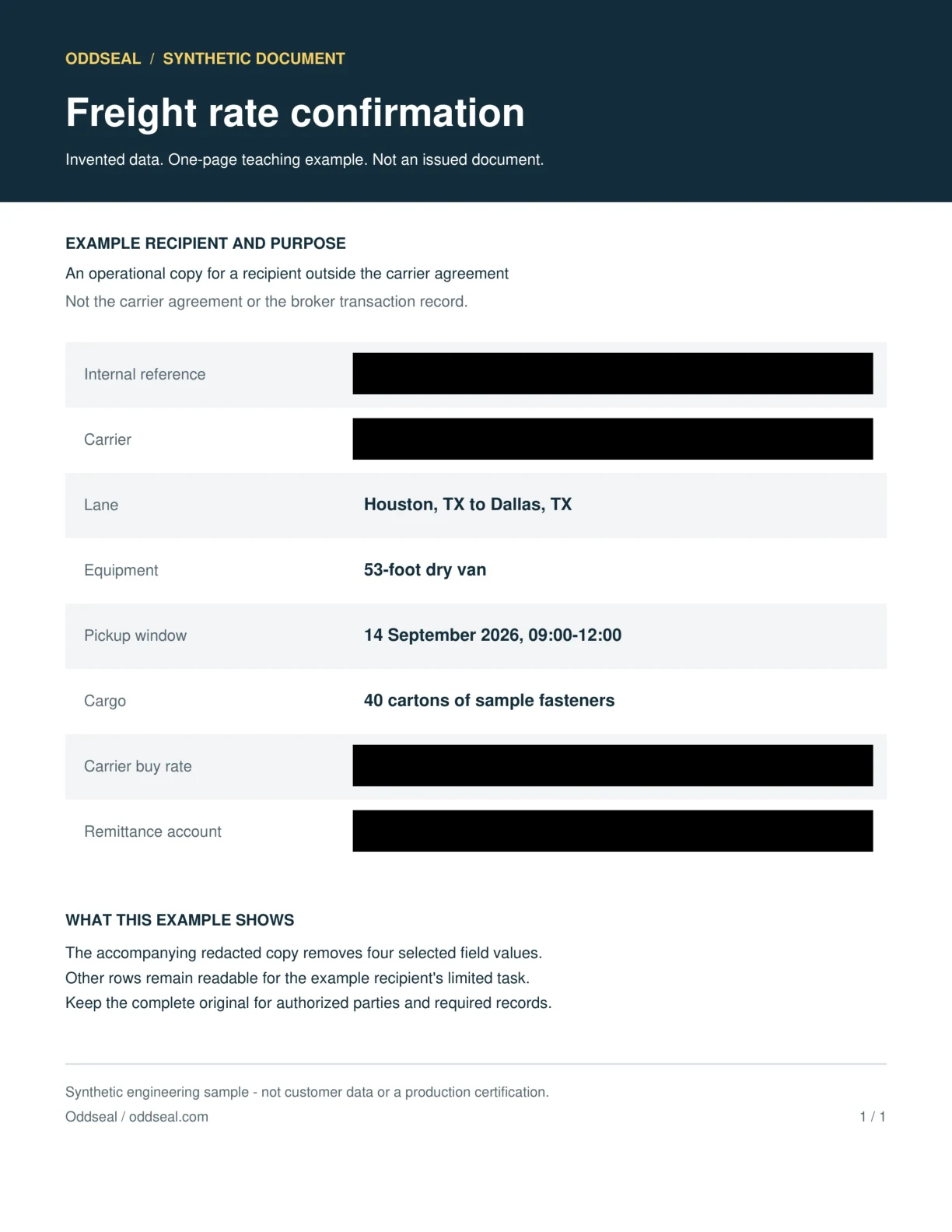
- Removed in this example
- Internal reference · Carrier · Carrier buy rate · Remittance account
- Kept visible for this recipient
- Lane · Equipment · Pickup window · Cargo
The sample was generated and checked locally with Oddseal’s engine using four manually selected regions. The redacted PDF was built the same way as in the product: each page rendered to a fresh 240-DPI image with the masks burned in. The evidence download records file hashes, versions, and the checks run.
Those local checks include page-level comparisons from Oddseal’s offline test profile that the product does not run on every document. Before sharing, the product runs a narrower check: an independent readback of the stored file plus a structural check.
The output samples are image-only PDFs with no searchable text layer. An empty text search is expected and cannot establish that a visible region was removed. Compare the page images and read the check evidence.
This is engine-level evidence for invented examples. It does not test automated detection, a production account, the application’s release checks, or share links. It is not a claim that every sensitive detail was found.
Which rate-confirmation fields deserve review?
First identify whether the recipient is a party to the shipment, a customer receiving a limited copy, or an outside reviewer. Their rights and operational needs differ.
Line-haul rate, fuel, accessorials, and total
The contracted carrier needs the amount it agreed to receive. A customer or prospect may not need the broker's buy-side breakdown or margin evidence.
Reference: 49 CFR 371.3, records to be kept by brokers
Carrier identity and registration numbers
Legal name, address, MC number, USDOT number, and contact details identify the performing carrier. Keep them for the carrier and required transaction records.
Reference: 49 CFR 371.3, records to be kept by brokers
Shipper, consignee, and facility contacts
Pickup and delivery parties, addresses, appointment contacts, and phone numbers are operational. Review them before using the document as a sample or external reference.
Lane, schedule, equipment, and cargo
Origin, destination, dates, equipment, commodity, weight, and handling requirements can identify a customer or shipment even after names are removed.
Payment and remittance details
Quick-pay terms, factoring instructions, bank data, invoice procedures, and payment contacts should remain only when the recipient handles settlement.
Load, purchase-order, and internal references
Reference numbers can connect the copy to TMS records, customer portals, other PDFs, or a specific lane history.
What should stay visible on a rate-con copy?
A party performing or settling the move needs complete agreed terms. A customer-facing or sample copy can have a narrower purpose.
Contracted motor carrier
- Keep visible
- Keep the carrier identity, agreed rate and accessorial terms, route, schedule, cargo, instructions, contacts, and payment process.
- Review before sharing
- Review unrelated customer pricing, margin notes, internal comments, and contacts that do not support the carrier's work.
Customer or consignee
- Keep visible
- Keep shipment instructions, service facts, their own contacts, and the commercial terms that govern the customer relationship.
- Review before sharing
- Review the carrier buy rate, carrier contact trail, broker margin, factoring details, and internal load references.
Tender, prospect, lender, or diligence reviewer
- Keep visible
- Keep dates, document structure, general lane or service evidence, and enough value context to support the review.
- Review before sharing
- Review exact rates, party identities, facility addresses, load numbers, signatures, and payment instructions.
Transaction party, auditor, regulator, or claims reviewer
- Keep visible
- Preserve the full agreement and the broker transaction record required for the review.
- Review before sharing
- Do not use a limited marketing or diligence copy to answer a request for the complete transaction record.
How to redact a rate confirmation copy
Keep the signed or accepted carrier agreement and transaction record unchanged. Build the limited copy from a duplicate.
- 01
Identify the agreement parties
Confirm who accepted the rate and who is requesting the copy. A party to the transaction may need information that an outside reviewer does not.
- 02
Define the disclosure purpose
State whether the copy supports customer communication, a tender, a reference, diligence, or another limited commercial review.
- 03
Review commercial and operational fields separately
Mark rates, margins, and payment details as commercial fields, then check route, schedule, cargo, equipment, and contacts against the recipient's operational task.
- 04
Check cross-references and signatures
Inspect load numbers, TMS references, purchase orders, email addresses, phone numbers, stamps, signatures, headers, and footers across every page.
- 05
Create a permanent derivative
Remove the approved targets from a new PDF. Do not rely on drawn boxes, annotation layers, white text, or cropped views.
- 06
Check and keep records separate
Open the output, confirm each selected rate and identity is covered and the terms you kept are readable, label the copy for its purpose, and retain the complete agreement under the applicable record policy.
What does Oddseal check on a rate-con copy?
Oddseal applies the selections the reviewer approved to a new PDF and blocks download and sharing when that file fails its pre-share check.
What the check covers
- Selected rates, party identities, account details, and references are burned into black masks on a fresh 240-DPI page image. Nothing under a mask can be copied or searched because no text is left underneath.
- Before download or sharing, an independent reader opens the stored file and confirms the expected page count, no extractable text, and no attachments, JavaScript, or open action, alongside a structural check of the file.
What it does not cover
- It does not check that every value you meant to remove was selected. A value you leave unselected stays visible in the image.
- It does not change a transaction party's record-access rights or the broker's recordkeeping duties.
- It does not show that detection found every commercial, personal, or identifying field.
Sources and evidence
These sources explain the document requirements, redaction methods, or example checks cited in this guide. Requirements vary by document, route, contract, and jurisdiction. A linked proposal is background, not an operative rule.
Federal Motor Carrier Safety Administration via eCFR
49 CFR 371.3, records to be kept by brokers
Lists U.S. broker transaction-record fields, the three-year retention period, and transaction-party review rights.
Federal Motor Carrier Safety Administration
Transparency in property broker transactions
Provides rulemaking background on broker records. A proposal does not itself change the operative rule; consult the current eCFR text above.
Information Commissioner's Office
Disclosing documents to the public securely
Provides a practical permanent-redaction and hidden-information checklist for electronic disclosures.
Related reading
Check a redacted freight PDF
Test the output yourself and see what Oddseal's pre-share check covers.
Why black-box redaction fails
See how drawn boxes leave text behind and how to test a PDF for it.
Freight document redaction guide
Set a recipient-first policy before selecting commercial fields.
Redacted freight contracts
Prepare a redacted copy for tenders, references, and diligence.
Redact a commercial invoice
Handle pricing and payment fields in a different operative record.
Start on Oddseal’s Free plan: 5 documents a month, no card needed.